Morocco’s First National Pavillion at Venice Biennale
Morocco’s first national pavilion at the Venice Biennale is now open – and it’s a huge moment for the artistic community here.
While Moroccan artists have consistently shown work at previous editions of the Venice Biennale, this is the first time Morocco has had its own distinct national presence at the iconic contemporary art event.
Morocco has now staked its cultural authority on the international art stage and, after 20 years of championing Moroccan art here at El Fenn, we couldn’t be happier.

Pavilion of the Kingdom of Morocco at the Biennale Arte 2026. Aseṭṭa. Created by artist Amina Agueznay. Courtesy of the Ministry of Youth, Culture and Communication of the Kingdom of Morocco © Matteo Losurdo
Amina Agueznay’s Asetta
A huge installation named Asǝṭṭa, the Amazigh word for the process of looming and weaving, has been specifically designed for the Biennale and is now on show in the Moroccan pavilion. It was created by artist Amina Agueznay, who works from an atelier in Marrakech, and curated by Meriem Berrada, artistic director of the city’s Museum of Contemporary Art Al Maden (MACAAL).
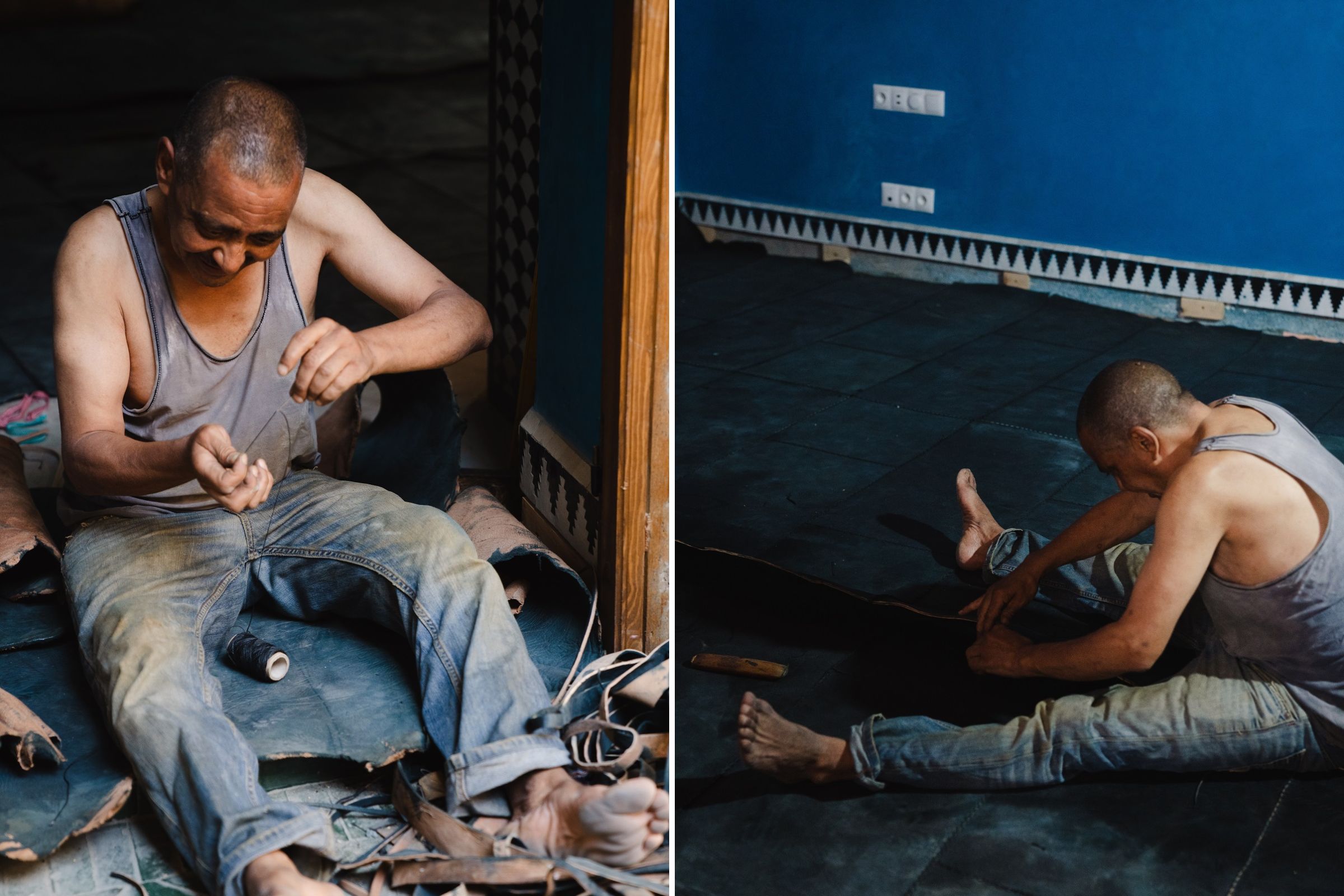
Agueznay worked with 166 Moroccan artisans to create more than 200 massive woven panels that showcase the country’s many forms of artisanal skills. Woven from naturally dyed and spun wool from the Tiflet region, they feature the colours of Morocco, as well as traditional geometric and ancestral shapes. Numerous artisanal disciplines – from embroidery and basketry to jewellery-making – are fused with the weaving and showcased in the installation.

Amina Agueznay at work
‘The intention is to highlight those discreet gestures and stories which, through their transmission, shape the history of territories – past, present and future,’ says Agueznay.
‘Asǝṭṭa is a monumental installation focusing on collaborative practices passed down through generations, embodying ancestral narratives that have always held deep significance, never more so than now.’
Influential online platform Artsy has named the Moroccan pavilion among its top ten at this year’s event.
Its critic wrote: ‘The result celebrates Morocco’s stunning textile traditions while also revealing how such rituals shift and build over time—how even the most ancestral art forms evolve through collaboration and experimentation. ’

Pavilion of the Kingdom of Morocco at the Biennale Arte 2026. Aseṭṭa. Created by artist Amina Agueznay. Courtesy of the Ministry of Youth, Culture and Communication of the Kingdom of Morocco © Matteo Losurdo
It’s a vital moment for the Moroccan art scene. When El Fenn opened in 2004, the country had a vibrant, but still largely internal, art tradition and was mostly invisible on the international market.
Some individual artists, including names such as Farid Belkahia and Mohammed Melehi, had broken through. But the infrastructure crucial to growing awareness of the country’s art scene, such as prestigious museums and galleries, was still evolving. Morocco’s first museum dedicated to contemporary art for instance— the Mohammed VI Museum in Rabat — didn’t open until 2014.
The Marrakech Biennale
One of the keys to externalising Morocco’s rich artistic traditions and putting it on the international cultural map however was the Marrakech Biennale. It was established in 2005 by El Fenn co-founder Vanessa Branson, who went on to helm six successful editions.
The event became one of the most significant Biennales outside North America and Western Europe, connecting artists, gallerists and collectors from all over Africa and the Arab world. And the seeds it sewed are still present today. Dana Awartani, who showed at the sixth edition of the Marrakech Biennale 2016, is now representing Saudi Arabia at the 2026 Venice Biennale.
The Future is Looking Bright for Moroccan Art
Since then, the evolution of Morocco’s art scene has been further accelerated by prestigious events such as the 1-54 Contemporary African Art Fair, which holds an edition in Marrakech each year, as well as New York and London. Key institutions including MACAAL have also developed Morocco’s reputation as an art hub, as well as the opening of a string of notable galleries in Marrakech and other major cities.
But now, the inclusion of the Moroccan pavilion marks a new chapter in the country’s art story. And we’re delighted that the spotlight is falling ever more brightly on the incredible talent here.