Meet the Master Maker Behind El Fenn’s Tiled Walls and Floors
Mention Moroccan design and one thing will usually top the list: zellige tiling. The intricate shapes, patterns and colours of zellige mosaics are a key element of Moroccan interiors.
And it continues to pack a mighty artisanal punch to this day. Made by hand, zellige is not uniform. The ‘imperfections’ expresses the presence of people in its production. That’s its beauty.

A HISTORY OF ZELLIGE
The earliest fragments of zellige were found in Tunisia and are thought to date back to the tenth or eleventh century. The tiling went on to become a defining feature in the interiors of Northern Africa and Andalusia. They are used everywhere from walls to fountains and minarets.
The complex mosaic patterns we know today were popular by the early fourteenth century. But over time, the use of zellige lessened in places like Tunisia and Andalusia. In Spain, zellige became so popular that tilemakers had to develop new production methods to allow them to mass produce tiles. But the popularity of zellige never waned in Morocco. Here, age old production techniques held firm.
That tradition is very much alive at El Fenn, where our zellige is the work of master tiler Ali Sahdane.

MEET ALI, THE EL FENN MASTER TILER
I grew up about 100km from Fez, which is home to thousands of artisans and known throughout Morocco for its particular style of zellige. After leaving school aged 14, a cousin who had trained in zellige and worked on houses in Fez offered to take me on as an apprentice.
It took about five years to learn the techniques – starting with precisely cutting the tiles into the many different shapes used in zellige, before learning how to apply them to walls and mastering the many patterns. All the zellige tiles used in my projects are made by hand in Fez by specialist cutters who work entirely by eye and feel, using a small hammer and a pointed blade called a menkach. The technique has remained unchanged for centuries and key shapes include bejmat (herringbone), ddoudab (5cm square), marabaa (3.5cm square) and dreeham (2.5cm square).

After qualifying as a master craftsman I remained in Fez for several years, working on projects including royal palaces and the University of al-Qarawiyyin, which was founded in the ninth century. Some of the projects took years and working on them, in such special buildings. This taught me a lot. I then moved to Tangier to work on a mosque before taking on projects in Kenitra and Rabat, eventually settling in Marrakech.
I started working at El Fenn in 2012 and have worked on many of the bedrooms and courtyards, as well as the Colonnade café, over the years.The beauty of zellige is that there are infinite patterns you can create, and many uses – from walls to furniture such as tables. The principles are timeless but you are always learning. There are always new techniques and new patterns to discover, which is what makes it such a creative discipline.
I’m very happy in my work. It wasn’t my choice to work in zellige. I’d left school, needed to work and found an opportunity. But while I didn’t go to the zellige, it came to me. I love everything about it. You have to use your imagination to create something new and, after more than 35 years, it’s still interesting.

DISCOVER MOROCCAN ZELLIGE FOR YOURSELF
One of the finest examples of zellige in Marrakech can be seen at the Ben Youssef Madrasa, where panels in deep blues, greens and ochres line the courtyard walls, still sharp enough up close to make out the individual hand-cut pieces.
Bahia Palace is another good stop. Its many courtyards are laid with zellige underfoot as well as on the walls. And keep an eye out at the Saadian Tombs, where zellige panels sit alongside the marble columns in a much smaller, more intimate setting than the palaces.
You can also explore our Top 5 Marrakech Museums guide to explore more artisanal history.
MEET THE MASTER ARTISANS THAT SHAPE EL FENN
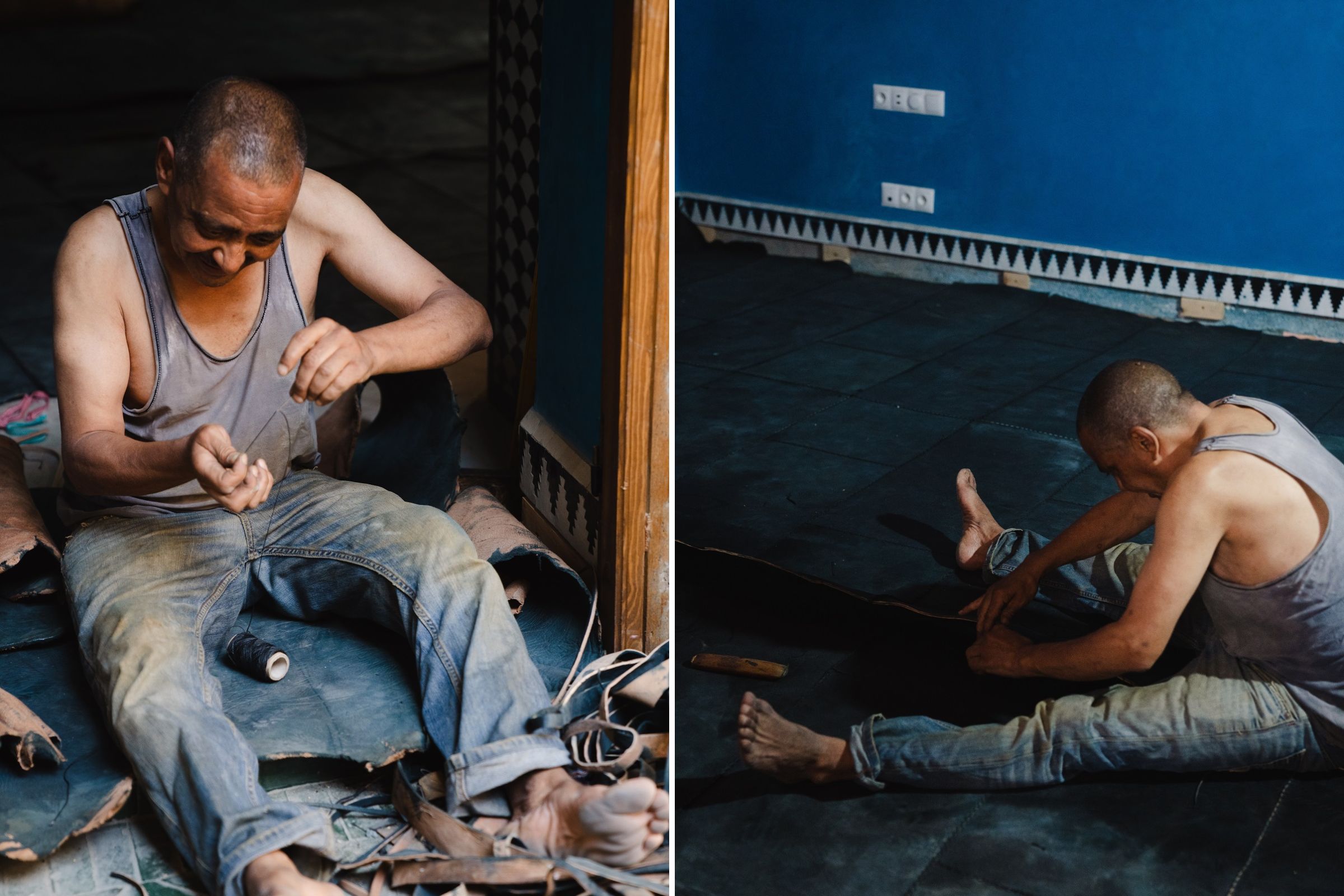
Ali is one of several master craftsmen whose work shapes El Fenn. Meet Mohammed, the mellem behind our carved plasterwork, and Abdellah, the leatherworker behind our bedroom floors.