Meet the Master Maker Behind Our Iconic Plasterwork
Plasterwork is one of Morocco’s most iconic artisanal disciplines, and here at El Fenn it shapes almost every surface you touch including walls, floors, baths, courtyards, archways. Two distinct traditions sit behind it: tadelakt and gebs.

TADELAKT
Tadelakt, (pronounced ta-dee-lact) is a form of lime plaster which is mixed and applied entirely by hand. This is what gives walls and floors their richly coloured, tactile feel. Once applied, it’s rubbed smooth with stones and finished with olive oil soap to create a soft, waterproof sheen. This is why we also used it for baths, sinks, fireplaces and even bed frames.

The colour comes from pigment mixed in by hand just before application, so no two surfaces are ever quite the same. Tadelakt develops a beautiful patina over time too. It is durable and robust but fades gently in patches. We think this only adds to its character. The word itself derives from an Amazigh term meaning “to rub in,” and while it’s thought to descend from qadad, a plastering technique from Yemen, Moroccan artisans made it entirely their own.

CARVED PLASTERWORK
Alongside it is carved plasterwork, known locally as gebs – the ornate, hand-chiselled patterns found across our courtyards, archways and colonnades. Gebs is carved dry and entirely freehand, without stencils or moulds. They use techniques passed down through generations of master craftsmen, or mellems.

MEET MOHAMMED, THE EL FENN MASTER CARVER
My father was a builder in the Ourika Valley where I grew up and he worked with a plasterer on construction projects. This is how I started to learn aged 15. Back then, I did commercial plastering but after working on a hotel project in Essouira and seeing artisans doing hand-carved plaster, I decided to become an apprentice with a mellem – or master craftsman.
It took four years because I started by just preparing his materials. But bit by bit he started to show me how to work the plaster and I would practice after work. When he saw how interested I was, he would give me small pieces of work and would show me the techniques and tools. Four years later, I became a mellem when I was 21.
More than twenty years later, I’m still interested in everything about the craft. Moroccan carved plasterwork traditions and designs stretch back centuries and there are almost limitless possibilities of shapes and designs. Each one has a name but core patterns including dafra (plaits), taourek (leaves) and shamsiya (stars/suns) feature regularly.
The plaster is made using gypsum and two layers of plaster are applied before the third, and final, is carved using chisels and picks of different widths. The geometric patterns are rooted in mathematical principles but everything is done freehand, without stencils or guides. The key is to carve the plaster at exactly the right moment, when it’s firm enough to hold a clean edge but not yet fully set.

Here at El Fenn I’ve worked the courtyards and the colonnades and the time it takes depends on the intricacy and scale of the design. The large carved archway in the orange and lemon courtyard for instance took me about four weeks.
Being a mellem means of course that you have a certain level of knowledge. But what makes my work so interesting is that you’re always discovering and developing techniques so you can never really say you are a true mellem. You learn the basic skills when you train but you are always learning and even today people ask for designs that I’ve never done so I have to expand my knowledge.
Right now though, many craftsmen are disappearing. The younger generation are not so interested in studying traditional craft. Silicone moulds are also being used more and more because the process is less time intensive and therefore cheaper. People’s mentality has changed and I worry the craft will die out.
But it’s important to keep the old techniques. Plasterwork is a signature of Moroccan traditions and we need to preserve it. There’s a beauty to artisanal plaster because of its imperfections, and a history that no machine or mould can ever reproduce. That’s why I’m glad that there are still places like El Fenn that want to do things traditionally.

DISCOVER MOROCCAN ‘GEBS’ FOR YOURSELF
Mohammed’s carving is everywhere here at El Fenn, but gebs is worth seeking out beyond the hotel too.
The Ben Youssef Madrasa in the medina is widely considered the finest example in the city. You’ll find courtyard walls carved with floral motifs and interlacing patterns with Quranic calligraphy. Bahia Palace is another good stop, its reception halls and courtyards are dense with gebs on a grander, more theatrical scale.
MEET THE MASTER ARTISANS THAT SHAPE EL FENN
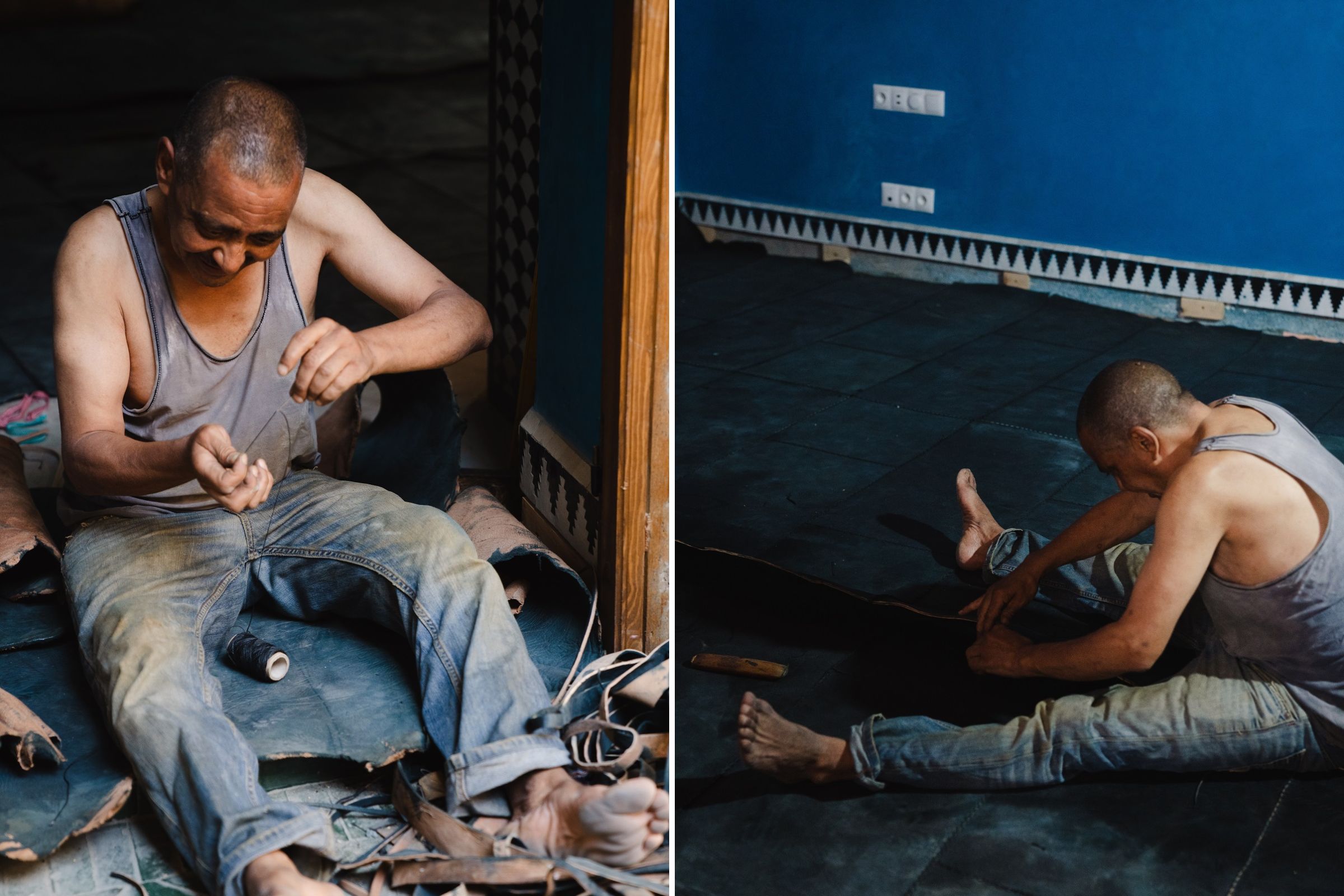
Ali is one of several master craftsmen whose work shapes El Fenn. Meet Ali, the master zellige tiler, and Abdellah, the leatherworker behind our bedroom floors.